Wednesday, October 10, 2012
The View From The Dumpster May Be the Clearest
My
husband and I were watching one of our favorite movies the other
night, Rear Window, when one
of the characters made a really interesting remark. She was Stella,
the traveling nurse who pays regular therapeutic visits to “Jeff”
Jeffries for his broken leg. She told him that she had predicted the
stock market crash of 1929, and that it was easy to do so. But not
because she was an economic wiz. One of the Vice Presidents of GM
was a patient of hers, and he was having kidney trouble. “When
General Motors has to go to the bathroom 10 times a day,” she said,
“the whole country's ready to let go.”
Her
remark made me remember my experiences working for Borders Books & Music, at
a superstore in Phoenix. No one was running to the bathroom 10 times
a day (okay – sometimes I
was), but something else really revealing was going on. I did a lot
of work in the stock room, receiving, sorting, and stickering product
to be shelved. I also helped to throw away our gigantic pile of
trash every day. Eventually I realized that more paper was going
into that dumpster than was going out the front door as purchased
books.
This
was mind blowing. I tried to imagine businesses all over the
country, throwing away all that stuff. I think if all of us could
really see how much of it there is on a daily basis, we would decide
something had to be done about it. Why? Because that's energy we're
throwing away. That's cellulose, which could be converted back into
fuel, or fertilizer, or heat, and we're paying people to ship it
around the country and then throw it in dumpsters. In our case, it
was tons of cardboard: boxes and display materials. We re-used a small portion of those boxes to
ship returns to our distributor (more about that later), but most of
them went straight into the garbage. One of our line employees tried
to suggest that we could get paid for the cardboard by a recycler who
specialized in pick-ups from businesses. Our District Manager
dismissed his suggestion, and when he went over her head to suggest
it to the Regional Manager, he was warned that if he did that again
he'd be fired. Yes, it's not considered kosher to go over the head
of a superior. But our company used to have a system in place where
line employees could make suggestions to the Brass upstairs – but
they never accepted any of those suggestions, and eventually that
system went away.
Eventually
our company did, too.
Before
the crash, I watched an interesting progression take place. In the
early, halcyon days we got gigantic shipments of books, magazines,
movies, and music. We sold a lot of that stuff, but so much of it
was coming in, a lot of it never made it to the shelves. We didn't
have an efficient system for getting those books and CDs on carts and
then on the floor (let alone in the proper
alphabetical order in the right section). So when I trained as a
sales clerk, the rule was that if a customer came in looking for an
item, there were seven places you had to check before giving up and
admitting defeat (Can I order that for you, Ma'am?) – the sorting
bins were one of those places.
Returns
were also a challenge – we had a list of items we were supposed to
return every month. When we looked for that stuff, we often found it
in those bins. In the beginning, it was stuff that didn't sell very
well (sometimes because it never made it to the floor) and we
returned it so we could get stuff that did sell
well. By the end, we were using those returns to finance our new
stock purchases (instead of profit from sales). We would return
stuff one month, and order the same stuff for the next. It was
beyond bizarre.
What
it amounts to is that we used to sell more paper than we threw away.
We also used to sell more paper than what we shipped back to the
distributor. After 9/11/2001, the trend slowed, and then reversed.
But lest you think I'm blaming terrorists for the demise of Borders,
let me point out one other ugly trend, the one driven by customers:
returns at the register.
In
an ideal situation, customer returns are rare. You sell a good
product, they find it useful, they keep it. When I first began to
work at Borders, the return rate at the register was actually kind of
high already. A lot of it was driven by fraud (people would pull
items off the shelf and claim they were returning them so they could
use the credit to buy other items). Our return policy was
ridiculously lenient, and it didn't take long for termites to settle
in. But they weren't the only culprits, and in the end they weren't
even the majority of abusers. The majority were people engaged in
what I call Theft Of Services. These were folks who bought books,
read them, then returned them when they were finished. These folks
thought nothing was wrong with that, because the store could sell the
book, so where was the harm? The harm is that they returned the
physical book, but they stole the content. When the product is a
book, the physical copy is not the full extent of the product, it's
just the delivery system. The content is really the product. That's
why people can sell ebooks.
So
that's one of the major reasons that the ratio between the paper
going out the door as sold product and the paper being shipped back
or tossed into the dumpster got out of whack; paper started to come
back to us from another direction. Eventually, the number of people
coming to the register with returns went from 1 in 10 people to about
5 in 10.
By
that time, the economy had really tanked. A lot of folks were
returning those books because they couldn't pay their bills. But did
they do the honest thing and simply go to the library? Nope. And
because they didn't go to the library, they caused initial sales at our
stores to seem higher than they really were. Executives at our
company focused on those sales figures and mostly ignored return
rates.
These
same executives stepped up their merchandising campaigns. They paid Robert Sabuda, the wonderful designer of pop-up books, to design pop-up style
Christmas decorations for all the stores, paid to have them
constructed and shipped to the stores – then ordered us to throw
them all in the trash once the season was over. Chastened by
criticism from investors over this fiasco, they responded by paying
one of their colleagues in their own headquarters to design the
decorations for next year. His
designs were so creepy, we were actually grateful to throw them in
the dumpsters after Christmas.
You
might think some of that waste is necessary – after all, sometimes
you have to spend money to make money. That's what merchandising is,
and in stores you see it manifested as signs advertising the
products. Every month they sent us big packages of signage to put up
in the store. And it seemed like just about every other month
they e-mailed the managers and told them to throw out all that
signage instead of putting it up, because it was the wrong color.
That was about $60,000 that went into the trash for no good reason.
They could have just mailed us the money and told us to throw it
away.
So
to paraphrase Stella, if more paper is going into the dumpsters than
is being sold to customers, something's wrong. Most businesses
manage by numbers these days, but those numbers can be interpreted
different ways. They can be massaged. Our financial meltdowns in
1929 and 2008 prove that. So if you're thinking of investing in a
company that deals in physical products, you may want to check their
dumpsters. They may tell a tale that will make you change your mind.
Monday, October 1, 2012
The Great Wickenburg Escape
When
Ernie and I don't get to go out and hike on a regular basis, we get
kind of peaked. There is a world of wonder out there, and we're
stuck inside with our eyeballs glued to computer screens, typing our little hearts out and staring at facebook. In the best of all
possible worlds, this would not be the case. We would be traveling
around the Southwest, taking pictures, shooting amateur videos, and
writing about our travels. We would be living inside an Airstream trailer and posting regular reports on a blog about Weird and
Wonderful Travels On The Cheap. Some day, maybe this will come true.
But right now, it's all about the day job and the bills. So we try
to take day trips.
Ernie posted a report about our most recent trip to Wickenburg, The Hassayampa River Preserve, and the Vulture Mountains. He summed up the trip pretty well, so I will only add some photos with a bit of commentary.
The
visitor's center for Hassayampa River Preserve is a charming,
refurbished historic building that was a ranch and stage-coach stop
back in the day. Its courtyard was swarming with butterflies and
hummingbirds.
The
caterpillar-sized thingees in this web were wriggling, ever so
slowly.
One
of these days I'll create a site called Em's Happy Trails, and this
photo will be on it.
The
Hassayampa is an underground river – much of the time the water
stays underground. But in some places, it bubbles to the surface,
and in the preserve it forms a large pond (much loved by frogs,
birds, and bugs).
These
are raccoon prints.
These
are prints from the ring-tailed cat.
Datura
has a seriously cool seed pod.
This
wonderful spider actually constructed a pot-shaped house for herself,
then wove her web outward from the entrance. She let us know that
the only sort of visitors she likes are the edible kind.
This
is one of the few places in the basin-and-range provence of Arizona
where you will find a tree with fungus.
Remember
those recent pictures of Mars that proved water activity? This is
another example of that sort of -well, sorting. Rivers move rocks and
silt, and sort them by size. Fast-running water can move larger
stones; silt will be the last thing to settle out as the current
slows. A deposit of rocks that are more rounded and are about the
same size traveled a long distance from their source. Rocks that
have sharper edges and are a variety of sizes are still fairly close
to their source.
It
took me three tries to get this shot of a vermilion flycatcher – a
first for me.
I've
always wanted one of these Ocotillo fences.
Look,
we found Mecca! That's our truck parked out front.
When
we saw this guy from behind, I thought he was homeless.
A
Jack '0' Lantern saguaro near Vulture Mountains.
This
deposit of volcanic stuff is decaying into Tahiti beach sand.
Ocotillos are indicator plants -- evidence of underground water. They also like limestone (maybe because limestone tends to have damp, underground caves eaten into it).
This
guy lost most of his arms. He's got serious gnarlitude.
These
butterflies were imitating flowers.
By the way, you may be happy to know that apparently Doctor and Mrs. Doom have adopted a stretch of Highway 60. Just look for the sign as you drive along.
It
was a fabulous trip, but it made us long for more. So watch this
space . . .
Sunday, September 16, 2012
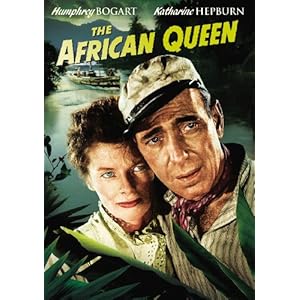
The Queen And The Falcon
Originally,
I was going to do this post about The Maltese Falcon,
which deserves a spot on anybody's Best Movies List. And for the
record, The Maltese Falcon
really is on my list. But since I'm limiting myself to ten (in no
particular order), I have to admit that I like Humphrey Bogart better
in The African Queen.
And it's not just because Charlie Allnut is a nicer guy. In a weird
sort of way, my choice between the two movies (and the two
characters) is like the difference between the dangerous kind of guy
and the good guy. You're attracted to the dangerous guy, but in the
end it's the good guy you end up marrying.
Both
movies have well-written stories and engaging plots. ButThe
African Queen has one other
bonus: Katherine Hepburn. While the Maltese Falcon is
about one guy, Sam Spade, and his search for the truth, The
African Queen is about two very
different people whose lives intertwine so successfully, they're able
to achieve the impossible (or at least the improbable).
Charlie
Allnut is a tugboat captain, an independent guy whose love of freedom
has taken him to Africa, a place most Americans will never see. The
political climate there is dangerous, so he has to be both smart and
courageous to pursue that freedom. But he's also a down
to-earth-guy, and when he meets Rose Sayer, he feels that they belong
to different classes.
And
he's right. She is the sister of a missionary, and her goal is to
help people find God. It's a goal that blows up right in her face,

leaving her with ashes, but Charlie rescues her in more ways than
one. Rose feels she has lost everything, but as she and Charlie get
into that boat and go crashing down the river rapids into an
uncertain future, she makes an observation that is my favorite quote
from the whole movie: “I never dreamed any mere physical
experience could be so
stimulating!” She loves that trip down the rapids. She begins to
develop an interest in the boat itself – and in the man who owns
it.
Katherine
Hepburn wrote a wonderful diary about the making of the movie, The Making Of The African Queen.
They filmed in Africa, and there were some issues with the water
which Humphrey Bogart and John Huston seemed to have neatly avoided
by spiking that water with a little whisky. The African
Queen is an essential John
Huston movie. Like the cast and crew, the characters are tested by
hardships. How they rise to those challenges defines their
character.
The
most charming moment in the film happens the morning after Charlie
and Rose have obviously been intimate with each other (a moment
handled with great sensitivity and discretion), and she says to him,
“Dear – what is your first name?” This romance
binds them together, but isn't the strongest thing doing so. That
would be their mission, which is to blow up a German warship that has
moored in the lake at the end of the tributary in which they are
struggling. They may be going through Hell, but it's not High Water
they're battling, it's low water,
which threatens to strand the boat. But they refuse to give up, even
when things look hopeless.
With
equal parts humor and tragedy, their struggle is engrossing. The
resolution of their story is both gratifying and believable. No
superheroes save the day, no wizards throw magic bolts of lightning
at each other. Instead, two people refuse to give up – and they
triumph. That's why The African Queen
makes the top ten, with no reservations whatsoever.
Thursday, August 30, 2012
Hal 9000 Was Not the First Computer Heavy In Movie History
Most
people who write a best movies list that includes a movie with
Katherine Hepburn choose something other than Desk Set. They
may prefer Pat & Mike or
Adam's Rib, titles
that are much better known. Almost certainly, they would name The
African Queen, which deserves to
be honored.
In
fact, The African Queen
will be the subject of my next blog entry. And of all the romantic
comedies that Katherine Hepburn and Spencer Tracy made together, Desk Set is my favorite – for one
simple reason. It's a science fiction movie.
No,
it doesn't have ray guns, space ships, or aliens. But it satisfies
one of the most basic criterions of a science fiction plot: it's
about how technology changes the lives of people who use it. In this
case, it's about a civilian application for an early computer, the
EMERAC (probably based on the UNIVAC and the ENIAC). Spencer Tracy
plays the efficiency expert who is adapting the computer for a
business interface, and Katherine Hepburn is the head of the
reference department at a New York Magazine that will try to
integrate the big computer into their operations. Since the computer
processes questions and is supposed to come up with instant answers,
the reference staff is understandably nervous about their jobs.
This
is one of the main conflicts in the story. The employees in the
reference department are all female, and you get a glimpse into the
lives of an earlier generation of working women. The wonderful Joan Blondell is Peg Costello – who, like the other gals in her
department, is single, independent, and older than people probably
expected a working woman to be in those days – old enough to be
married, in other words. They have to be ingenious to make ends
meet, but you get the feeling that none of them have met a man for
whom they would be able or willing to give up their independence –
except, possibly for Hepburn's character, Bunny Watson. She does
have a fella she's serious about: Mike Cutler, played by Gig
Young. But he keeps putting her off until his career takes off,
something it always seems to be on the verge of doing. By the time
the computer shows up, he's starting to take her for granted.
That's
the other conflict in the story. Because Tracy's character, Richard
Sumner, is quite charmed by her. He's fascinated by the way the
women perform their jobs, especially by the way their memories work.
He notices that Bunny uses association as a memory tool. And he
enjoys the quick, witty responses she comes up with when they talk.
I suspect he also notices her trim figure and dazzling smile, but he
is so unassuming and courteous, this is more of a conclusion than an
observation.
Bunny
tries very hard not to like Richard – after all, he's programming
the electronic monster that will make her obsolete. But something
between them just seems to click, and pretty soon the luke-warm
boyfriend begins to notice that he's got competition. Suddenly he's
not so inclined to take her for granted. But will he rally in time?
If
you're familiar with the pattern in Hepburn-Tracy movies, you already
know the answer to that question. But the characters are so likable,
you just can't help getting caught up in their lives. And in the
meantime, the big computer is looming over everybody's job, until the
day when it generates a bunch of pink slips for the reference
department. Neither love nor computerization goes smoothly for
anyone in this film.
But in the end, you cheer for both. Desk Set is not a grand film that forever changed the art form. But it is an irresistible snapshot of a particular time and place, a moment of change in American business and American romance. I watch it at least once every year, so I can take a brief vacation to that time and place. That's why it goes on my list of the best.
Wednesday, August 22, 2012
Shadows Of A Lost World
Many
people would put a movie by Akira Kurosawa on the list of top ten
films, and that choice would be justified. There are quite a few
Japanese filmmakers who have earned a place on that sort of list.
But for me, the first movie that always comes to mind when I think of
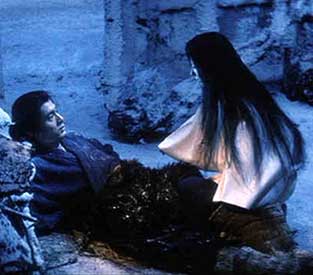
great Japanese films is the horror classic, Kwaidan, directed
by Masaki Kobayashi.
Based
on the ghost stories collected by Lafcadio Hearn, Kwaidan
is spooky, gorgeous, and fascinating. It takes its inspiration from
classic Japanese illustrations of ghost stories. The last time I
watched it I realized something amazing – this lavish production
was filmed entirely inside a studio. This includes a segment
depicting sea battles.
The
first segment, “Black Hair,” is not my favorite, but I like it
more every time I see it. I think it depicts the true experience of
a haunting, which is always more psychological in nature. A samurai
is sick of poverty, so he abandons his wife and marries the vain
daughter of a wealthy nobleman. His fortunes immediately improve,
but he can't forget the wife he so callously abandoned. Eventually
this obsession with the past wrecks his new life, and he goes home
again to salvage his old life. But what is waiting there for him? I
love the gorgeous, moody sets in this one. I especially like the
character of the spoiled new wife. She isn't likable, but she's very
interesting.
The
second story, “The Snow Maiden,” has a lot in common with
European fairy tales. A man witnesses a fey creature killing another
man. She almost kills him too, but she falls in love with him and
can't bring herself to kill him. Instead, she makes him promise
never to tell anyone what he's seen. The actress who plays this
creature manages to make her really scary, just with her body
movements and facial expressions. I think she takes her cues from
classical Japanese theater – at times her expressions are
mask-like. The same actress manages to look warm and kind when the
fey creature imitates a human woman so she can marry the man. The
outcome of this union also mirrors European folk tales – I won't
reveal it here. I love how this segment uses stage techniques for
its special effects.
My
favorite segment is the third, “Hoichi The Earless,” and I
suspect that's the case for most viewers. It has spectacular battle
scenes, and the way they're narrated is particularly brilliant.
Hoichi, a blind monk, is a very talented balladeer, and he knows the
story of the Dan-no-ura battle from beginning to end. As he performs
this ballad, the scenes are enacted. The camera alternates from
live-action segments (entirely filmed inside the studio, though
they're sea battles) to painted panels depicting the battle. You
could consider this the most kick-butt segment of the movie. But I
like it for more oddball reasons. To me, the ghosts in this segment
aren't just shadows of that battle and that ruined clan, they depict
a lost age. The remarkable formality of their lives, the protocol
dictating their day-to-day existence, is marvelous and awe-inspiring
– and lends credence to Shakespeare's assertion that all the world
is a stage.
An
interesting detail from the battle is a scene in which a woman leaps
into the sea with the young emperor rather than risk capture by their
enemies. This woman is steely in her resolve, a stark contrast to
the weeping young woman who quickly follows them into death. It took
me a few viewings to realize that the stern woman who orders her
followers into the sea must be the dowager empress – the boy's
grandmother, rather than his mother (the mother must be the weeping
woman). As the mother of the deceased emperor, she would have had
absolute authority until the boy came of age. Because of that
battle, the boy never gets the chance, so she takes him into the sea
to save honor, which she prizes above all else. Under the
circumstances, I can't blame her.
After that amazing third sequence, the final story, “In A Cup Of Tea,” is a bit of a let-down. I think the purpose of that sort of story in a book is to bring the readers back down to earth and end on a humorous note. But in the movie, I often find myself running out of patience with it before it's over. It probably should have been placed at the beginning instead of the end.
Despite
that minor flaw, Kwaidan still rises to the top. It will
always fascinate and chill me. It will always be on my list of top
ten movies.
Thursday, August 9, 2012
Truly Haunted
In
this age of ghost movies that rely on “boo” tactics and images of
people being thrown around rooms, a very important fact has been
mostly forgotten: a good ghost story is not about the ghost. It's
about the people being haunted by the ghost. If it's done well, the
audience will eventually realize that the ghost is not the only thing
haunting those people – possibly not even the most frightening
thing.
The Haunting is the best example of
that kind of ghost story. The book (The Haunting Of Hill House), by Shirley Jackson, is
one of my favorite novels – and the original movie, filmed in 1963
and directed by Robert Wise, is one of the few adaptations that
actually does justice to the source material. In fifty years, very
few movies have been made that can rival it in spookiness. And the
wonderful thing about it is that no high-tech special effects were
used – it was all great location, good acting, lighting, choice of
film stock, camera angels, sound effects and music, and on one
occasion a broom handle applied to an old-fashioned, moulded door.
You never see a ghost.
So
how can a movie that never shows a ghost be spooky? It starts with a
good story and some troubled characters. The premise in the
beginning is that some places are just bad. Maybe they started out
that way, maybe someone made them that way, or maybe it was a
combination of the two. Somehow a sediment of despair, sorrow, and
fear has accumulated there, and it affects everyone who visits. The
focal point of this wrongness is Hill House, a place built by an
extremely authoritarian man whose version of Christianity makes the
Puritans look like a bunch of free-love hippies. He wasn't content
just to build an imposing pile of a house – he has to make sure
that the place is a maze, both mentally and physically, where people
are lost and eventually trapped. The angles are deliberately off by
a few degrees; doors will silently swing shut if you've left them
open.
The
real setting of Hill House was a hotel in England, a beautiful place
that is made sinister by lighting, special film stock, camera angles,
etc. You get a glimpse of how nice the place really is when you look
at the scenes done in the breakfast room and the music room. Turn
the lights down and focus on some of the details of that house that
would seem charming and quaint in the daylight, and suddenly you see
faces among the leaf patterns on the wall and doorknobs that look
like they're watching you.
Add
the right characters to this setting, and things just have to happen.
Professor Markway (Richard Johnson) is the perfect guy to get the
ball rolling. He's a scientist to the core, looking for observable
phenomena that can be recorded and analyzed. He believes that what
seems to be supernatural is really natural-but-misunderstood. His
wife (played by Lois Maxwell) does not agree – she is not only
skeptical, but aggressively so, and very annoyed with him for
embarrassing her in the upper-class circles in which she runs. Luke
(Russ Tamblyn) is a spoiled rich kid who is simply hoping that he can
make a profit on the old pile once he inherits it. Theo (Claire
Bloom) is able to sense the thoughts and feelings of others, an
ability that has often made her unhappy. And then there's Eleanor.
Unfortunately
for Eleanor (Julie Harris), she has something in common with one of
the ghosts of Hill House. This similarity makes her especially
vulnerable to the house. On top of that, she's a sheltered woman who
was never able to spread her wings until this odd trip in which she
gets to belong to the team of investigators. She falls in love, and
the love can't be fulfilled.
I've
always thought that this team of characters could have carried a TV
series for at least a couple of seasons, if it were well-written. TV
executives would probably balk at the cost of special effects for
such a show, but that's the irony – CGI ruins ghost stories. The
old-fashioned, clever, and inexpensive effects of this movie are the
best sort of effects to use for story lines that rely on the
psychology of the characters – and the psychology of the audience.
When you watch The Haunting you believe you've seen things
that were actually never shown.
That's
true movie-making genius. And that's why The Haunting makes
my top ten list.
Tuesday, July 24, 2012
Cosmic Dad And His Robot
In
my previous Best Movie blog
entries, I've mentioned scenes that I believe to be the heart of
those films, the essential expression of their nature. In La
Belle et La Bete, it's the scene
where Belle and the Beast walk together in the garden for the first
time. In Bad Day At Black Rock,
it's the scene where Macreedy delivers a karate chop to Trimble, proving that
one-armed war veterans should not be underestimated by small-town
thugs.
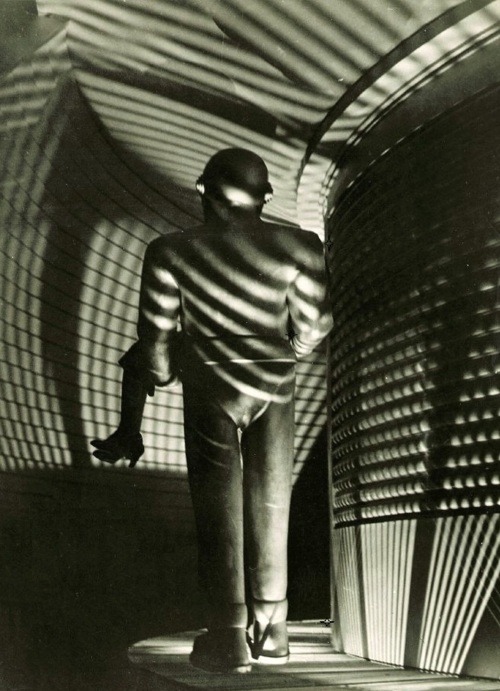
In
The Day The Earth Stood Still,
it's the scene where Klaatu signals Gort with the flashlight, then
enters his spaceship, while Bernard Herrmann's incomparable score
plays in the background (a segment called Nocturne/The Flashlight/The Robot/Space Control). With no dialog, it
manages to convey a supreme sense of wonder as we're invited into
that alien ship to glimpse the Unfathomable.
Like
Rear Window, The
Day The Earth Stood Still has no
wasted scenes, every frame counts. The difference is that the score
forThe Day The Earth Stood Still is
an integral part of the movie – it's essential to help tell the
story. Movies like this are one of the reasons music videos
eventually became so popular – images and sounds, when combined,
are powerful storytellers.
In
a way, it's surprising this movie ever got made. It's based on a
classic science fiction story, “Farewell To The Master,” (Harry Bates, 1940) which has a very different
plot. Only the basic premise of an alien visitation remains the
same, and the fact that there's a robot. These are nerdy elements,
and in those days they were usually relegated to the realm of the B
movie. YetThe Day The Earth Stood Still was made by an
A-list director, Robert Wise – which is why it also earned an A-list
composer for the score, and an excellent cast and script (Edmund H. North).
Many
people have seen a parallel to the storyline of the film and the
Jesus parable, with Klaatu as the Messiah. At one point, he is
killed and resurrected. But though Klaatu is ethical and wise beyond
Human standards, his message is not one of joy and peace. Basically
he's on Earth to tell us, Look, you're a bunch of destructive
yahoos. If you're so petty and foolish that you have to keep killing
each other, that's your business. But if you bring your conflicts
out into space, we'll blast you into oblivion. The choice is yours.
He
doesn't deliver that ultimatum until the very end of the movie – up
until that point, most of the humans he encounters spend their time
proving that his lack of faith in us is utterly justified. People
react fearfully, and the government fails to approach Klaatu with
diplomacy (they opt for the Scorched Earth approach). A few of the
people he meets manage to win him over. You never get the impression
that he hates us, just that he's disappointed that we can't grow up
and get a clue. Heck, I'm disappointed by that, too. Being a member
of the Human Race is like having a cousin who's a great guy –
unless he's drinking.
Both
Michael Rennie and Patricia Neal give their characters extraordinary depth. They come from a time when “The Theater”
included plays acted on stage. In the early days of Hollywood,
casting directors recruited heavily from a stable of extremely well-
trained and talented character actors from that earlier tradition.
This is one of the things that puts the Day The Earth Stood Still
in a category above many of the Science fiction B films of that
era (fun and imaginative though they could be).
The
special effects are fairly minimal – just some minor animation when
Gort disintegrates guns and tanks (also a soldier or two when the
going gets tough). Everything else is camera angle, lighting, great
editing, perfect music. I'll take these old-fashioned psychological
effects over CGI any day.
Beyond
the fact that it's a great Science Fiction movie,The Day
The Earth Stood Still has a
personal dimension for me. The first time I saw it, I was about
eight years old, and my father didn't live with us. He and my mother
had divorced a few years before, but I didn't know that. He served
in the air force, and the Viet Nam war was still going on. I knew my
father was deployed there, so I assumed he wasn't home because he was
fighting in that war. I was only half right.
In
the movie, Klaatu befriends a boy. His behavior toward that boy is
fatherly, and I've always sensed a bit of romance between Klaatu and
Patricia Neal's character. When I saw Klaatu get into his ship at
the end of the movie and fly away, leaving the woman and her boy
behind, it broke my heart. It still does, every time I see it.
Subscribe to:
Posts (Atom)