Showing posts with label paleogeographic maps. Show all posts
Friday, December 7, 2012
Wayne Ranney: Geologist, Adventurer, and Mapmaster Flash
You
may recall that I mentioned, sometime in the recent past, the
paleogeographic maps are fabulous. Or you may not. But they are.
And what's even more wonderful is that Wayne Ranney, one of the guys
behind those afore-mentioned fabulous maps will be speaking at the
Heard Museum on Tuesday, December 11, at 1:30 p.m. To 3:00 p.m.
He'll be signing copies of his books in our book store afterward.
I've posted a review of the book he co-wrote with Ron Blakey, Ancient Landscapes of the Colorado Plateau,
which features maps that depict what the Colorado Plateau may have
looked like millions and even billions of years ago.
I will soon be
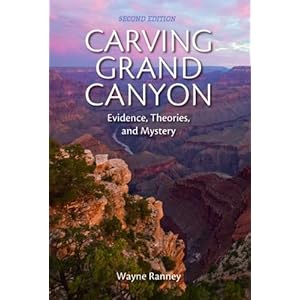
posting a review of Carving Grand Canyon: Evidence, Theories, and Mystery (2nd Edition) which casts light on past and recent arguments about when the Grand
Canyon began to form.
And I look forward to diving into Sedona
Through Time, which delves into
the formation of one of the most beautiful places on Earth: Oak Creek
Canyon.
We have all three titles available at the Heard Museum Book
Store, and Mr. Ranney will be signing there after his lecture. Don't
miss it!
Thursday, November 1, 2012
Paleogeographic Maps Are Fabulous
Think
of the nerdiest comic book fan drooling over his favorite graphic
novel - that's how I look when I have this book in my hands. As a
geology student who lives in Arizona, I have good reason to be such a
geek. Every time I visit the Colorado Plateau, I have a thousand
questions about how the strata formed. This book answers most of
those questions, and illustrates those answers beautifully with
diagrams, cross-section charts, photographs, and "paleogeographic
maps." Those maps allow the reader to see what the area may have
looked like in the past, from the last part of the Precambrian Era,
1.7 billion years ago, through the Mesozoic with its dinosaurs, to
the the Cenozoic and our present epoch. If you've ever tried to
visualize the supercontinents, or what the Four Corners area may have
looked like when it was turned on its side and hugging the equator,
the paleogeographic maps are hugely helpful.
Readers
who are more interested in archaeology will gain some perspective as
to why the ruins in the Southwest are unique - we've got the perfect
strata for canyons, creeks, and cliff dwellings. And anyone who would
like more background on the geology of their favorite National Park
on the Colorado Plateau will find this book handy. As for me, I'm a
happy geek pouring over the details of how each layer was formed and
where it's exposed in this landscape I love so much. I will refer to
this book again again, until it falls apart and I have to get another
one. It's money well spent.
Subscribe to:
Posts (Atom)


